We can provide for your piano’s needs. Here is a list of the different things a piano can need, and an explanation of what they are. Feel free to reach out with questions!
Tuning
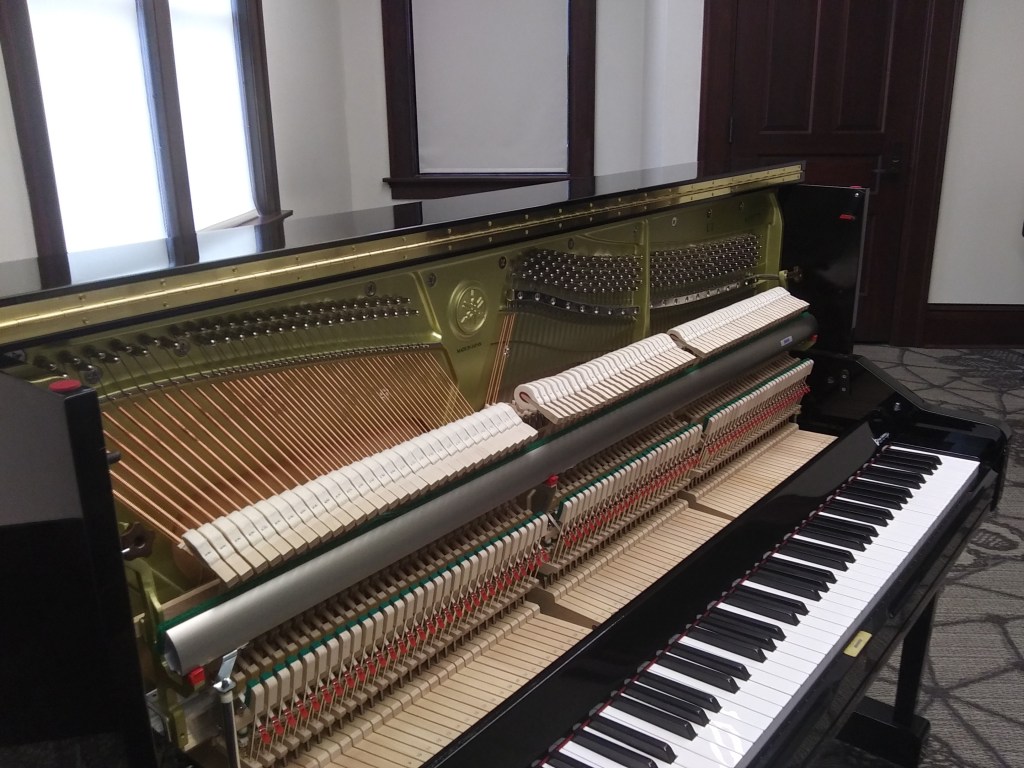
This is the most regularly required and basic service to a piano. It depends on your needs and climate, but generally a piano should be tuned every 6-12 months.
If the entire piano is sharp or flat from the correct pitch, a rough pass pitch adjustment will need to be performed. Once it is close, or if it was already close, it can be fine tuned.
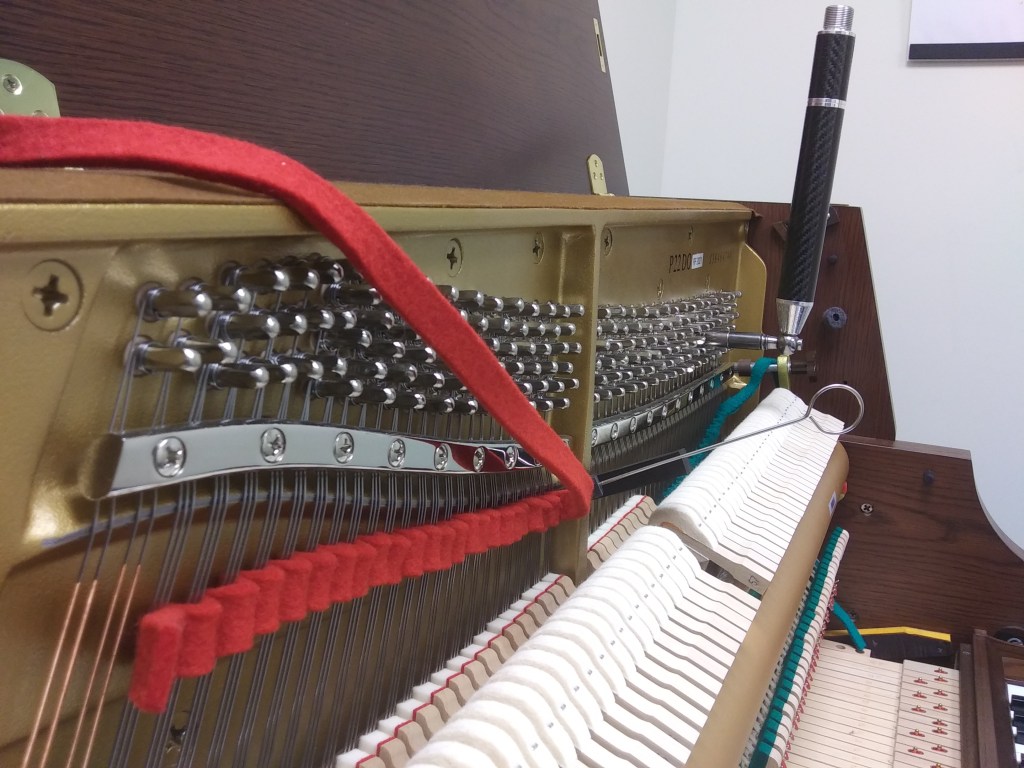
Most notes have 3 strings per note. I start by muting off two of those strings on each note, and tuning the single open string. Then, I tune the other two strings to the first string.
The key to a quality tuning is not only to get all the strings in tune with each other, but to settle them so they stay as well as possible.
Prices:
$40 for a rough pass pitch raise (if needed)
$140 for a final tuning
Cleaning
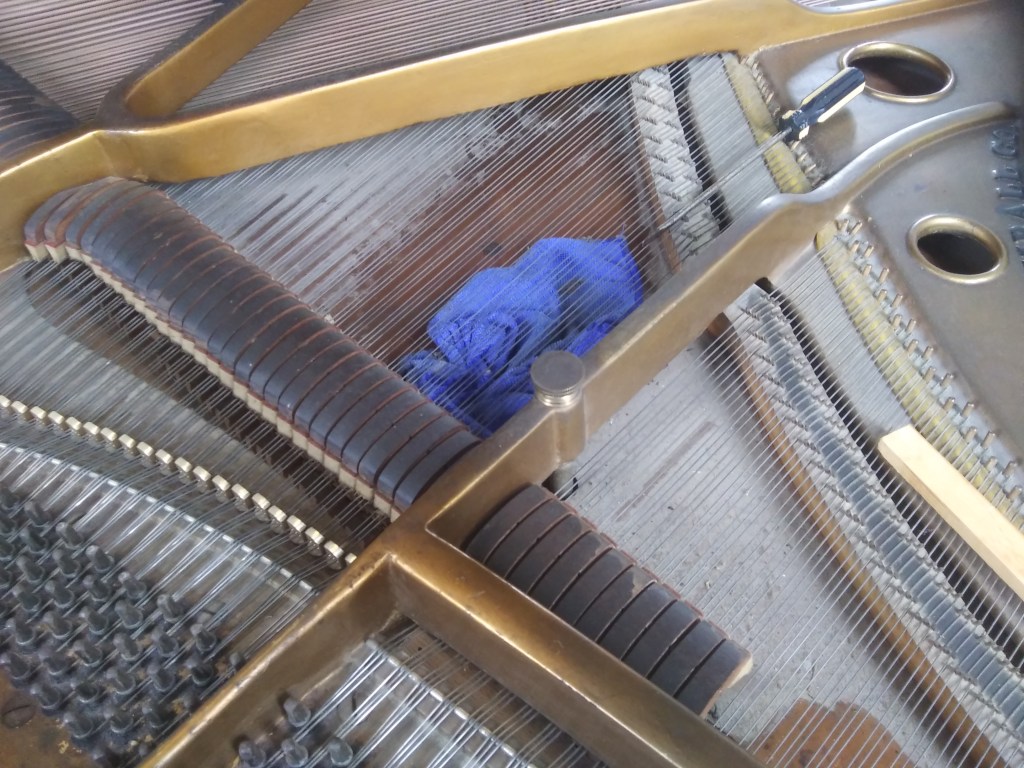
If a piano sits for years without being cleaned on the inside, it can get quite dirty. Not only will it be full of dust, but there there are usually various objects that have fallen in over the years, and sometimes dead bugs, or mouse scat or even nests. Grime on the key tops, and on the plate and soundboard in grands, and corrosion on the strings makes the piano less visually appealing.
A quick vacuuming out when the piano is dusty is complimentary with a tuning, but sometimes a more thorough cleaning is needed.
What a cleaning includes may vary somewhat depending on what is most needing cleaning, but it usually includes the following:
1) Vacuuming and wiping out dust from inside the cabinet and underneath the keys.
2) Vacuuming or wiping out the back of the soundboard
3) Cleaning the soundboard under the strings on grands
4) Cleaning corrosion off the strings (this can make them look much brighter; important especially on grands where the strings are seen.)
5) On grands, cleaning the plate in between the tuning pins
6)Cleaning the key tops
Price:
Basic Cleaning: Complimentary with a tuning
Deep Cleaning: $75
Repair
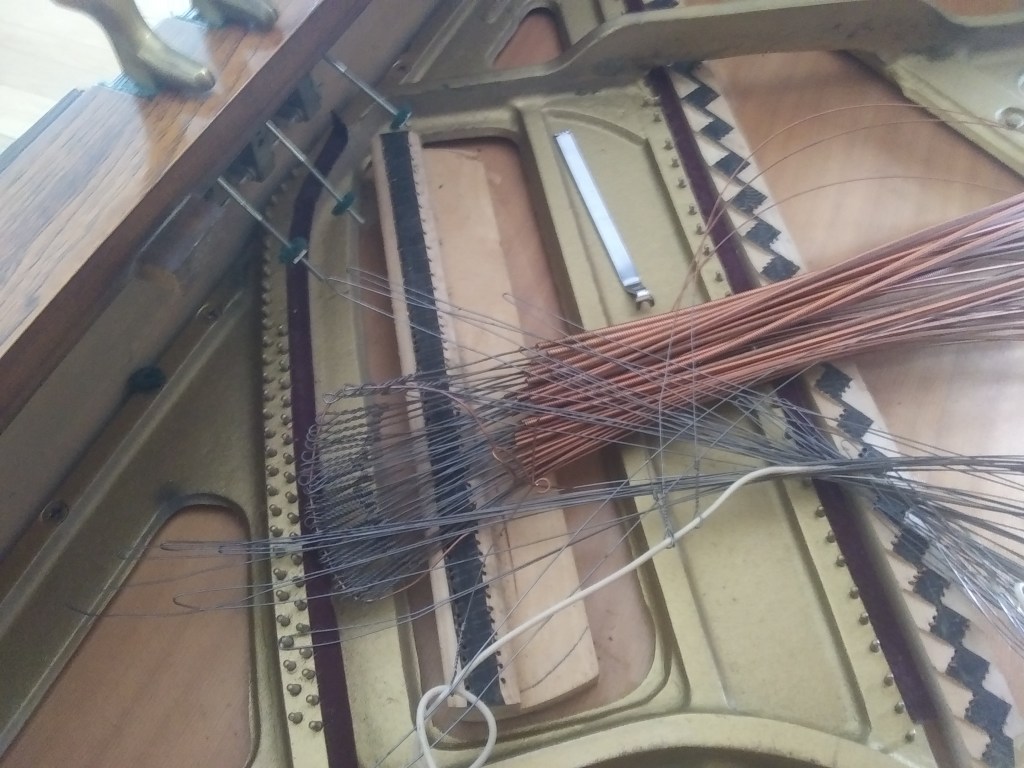
Something not working right? We can fix it!
Or pictured here is a piano on which I removed almost all the strings to repair a splitting bridge.
Prices Vary

Shape, Tighten, Align and Voice
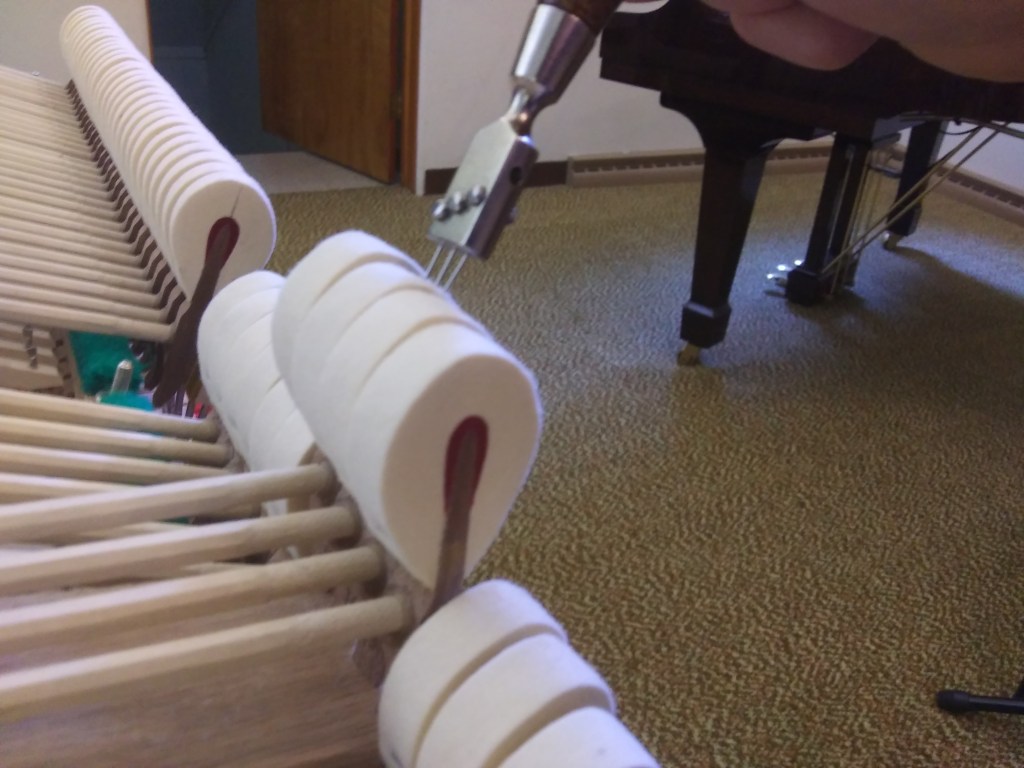
As the piano is played the hammer felt gets worn from striking the strings over and over again. These grooves can cause uneven and harsh tone. The hammers can be sanded back into a nice round and smooth shape, improving the tone.
In addition to shaping the hammers, the action screws are tightened to prevent potential clicks, and the hammers are aligned to the strings so that they will wear in the proper position.
A basic voicing is included. Typically, the hammers on an older piano are too hard, and needling the felt will soften it so it does not sound too bright and harsh.
Price: $225
Voicing
If the tone of your piano is not satisfactory, we can improve it. Sometimes, this may be a radical change to be much more mellow or much brighter. On high-performance pianos, it may be desirable to just even things out a bit to achieve optimal tone.
$100/hour

Lost Motion
On uprights, the felt cushion which the back of the key pushes on becomes compressed, resulting in a looseness in the key before it begins to move the hammer. This simple adjustment removes that wasted motion, resulting in more power and control.
Price: $30

Regulation
There are 13 or so points of adjustment per key in the action of an upright piano, and about 16 in a grand action. Multiply this by 88 keys, and there are well over 1000 adjustments with very narrow tolerances that affect the play-ability of the piano.
The adjustments in uprights include: Key level, dip, squaring, and spacing, loss motion, let off, hammer traveling, warping, and alignment to strings, hammer checking, bridal tape length, damper timing, and damper key lift timing.
In grands, the adjustments include: Key level, dip, squaring, and spacing, blow distance, hammer traveling, warping, alignment to strings with shift pedal, jack depth, repetition lever height, let off, repetition spring strength, alignment of back check to the hammer tail, checking distance, damper timing and alignment to strings and damper key lift, and sostenuto function.
Regulation takes a significant amount of time. Plan for a full day. On uprights, most of the work has to be done in the piano. On grands, about half of the work is done in the piano, and the other half I can do off site.
Prices:
Full Regulation requires that a Shape, Tighten, and align has also been done.
Full Regulation (Grand): $800
Full Regulation (Upright): $575
I can also do a partial regulation that will address the most critical needs. Prices will be less than the above, but will vary based on what the piano needs.

Parts Replacement and Action Rebuilding
If parts are old and cannot be brought up to satisfactory performance, they may need to be replaced. In some instances this would be partial — for instance, replacing just the hammers. Other times, rebuilding the entire action is what is needed.
Prices Vary
 Bontrager Piano Service